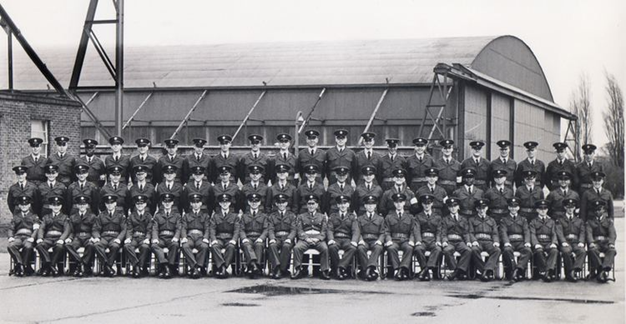
The site now known as Hemswell Industrial Park began life as a military airfield in 1918, when it was established by the Royal Flying Corps as a night landing and training ground.
In the mid-1930s, as part of Britain’s military expansion before the Second World War, the airfield was redeveloped into RAF Hemswell, officially opening on 31 December 1936 as a Bomber Command station. The airfield was built with four large “C-type” aircraft hangars with Hangar 3 being one of these original structures which formed part of the technical area of the base. During the early years of the Second World War, RAF Hemswell was home to several bomber squadrons. Aircraft operated from the base included:
Notably, aircraft from Hemswell were involved in some of the earliest RAF bombing missions of the war. On 19 March 1940, Hampden bombers from the base carried out one of the first attacks on German territory. Polish bomber squadrons (300, 301 and 305 Squadrons) were also based here between 1941 and 1943, playing a significant role in the Allied bombing campaign.
After the war, RAF Hemswell remained in military use through the early Cold War, including a period as a Thor missile base, before finally closing as an operational RAF station in 1967. Following closure, the site transitioned into civilian use. Much of the original infrastructure—including the hangars—was retained and repurposed for commercial and industrial use. Today, the former airfield forms Hemswell Cliff Industrial Estate, with many historic buildings still in use.
Hangar 3, one of the original wartime aircraft hangars, has been adapted for modern industrial use and now houses Hemswell Coldstore. Large RAF hangars such as this were ideally suited for conversion into cold storage facilities. Their strong construction, wide open internal space, and good road access made them practical for government and commercial adaptation in the post-war period, when efficient food storage and distribution became increasingly important across the UK. Today, the hangar continues to serve a vital role in the UK food supply chain, providing temperature-controlled storage and distribution services while preserving a piece of the country’s aviation heritage.
From supporting wartime bomber operations to safeguarding modern food supply, Hangar 3 remains a working part of Britain’s history.